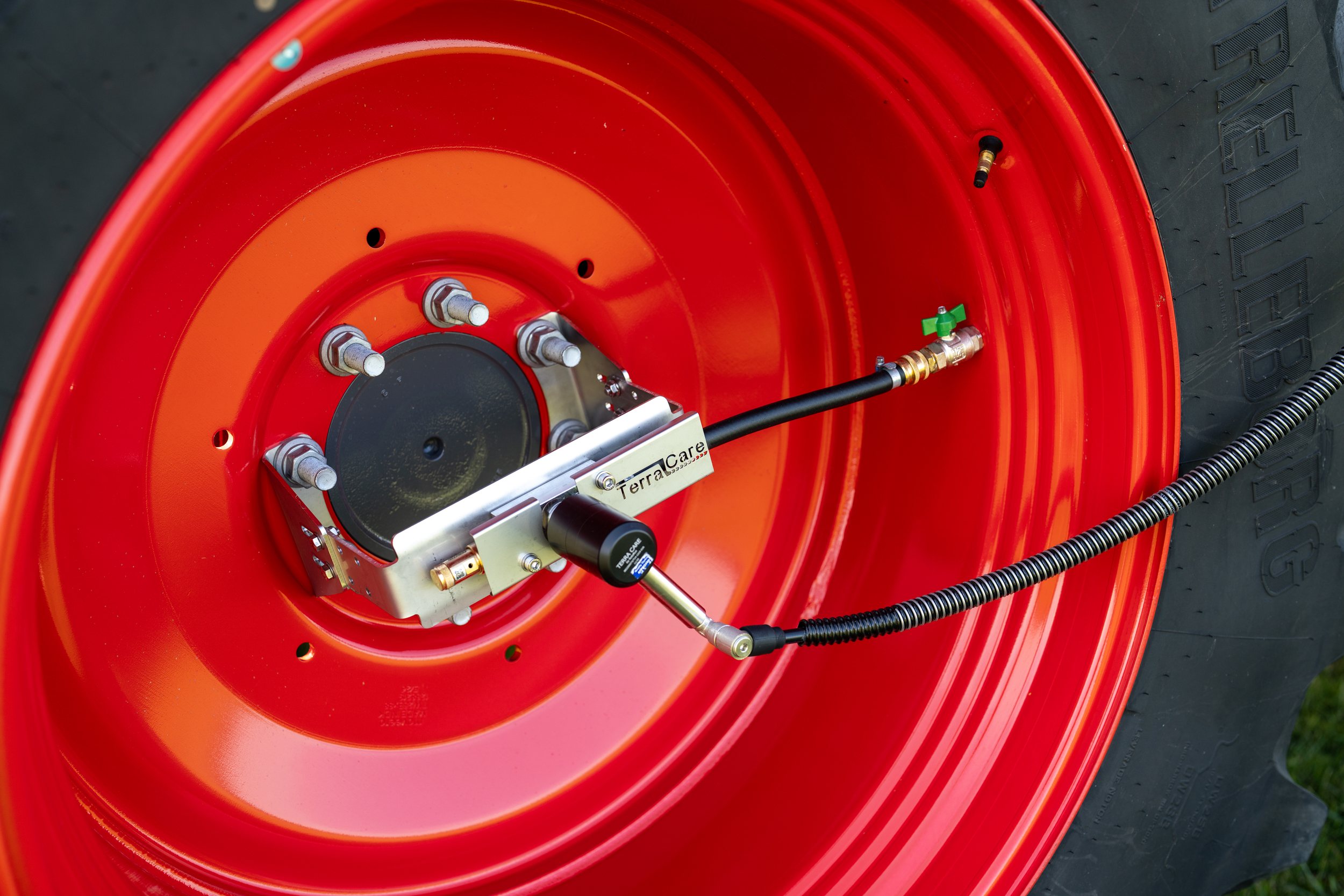
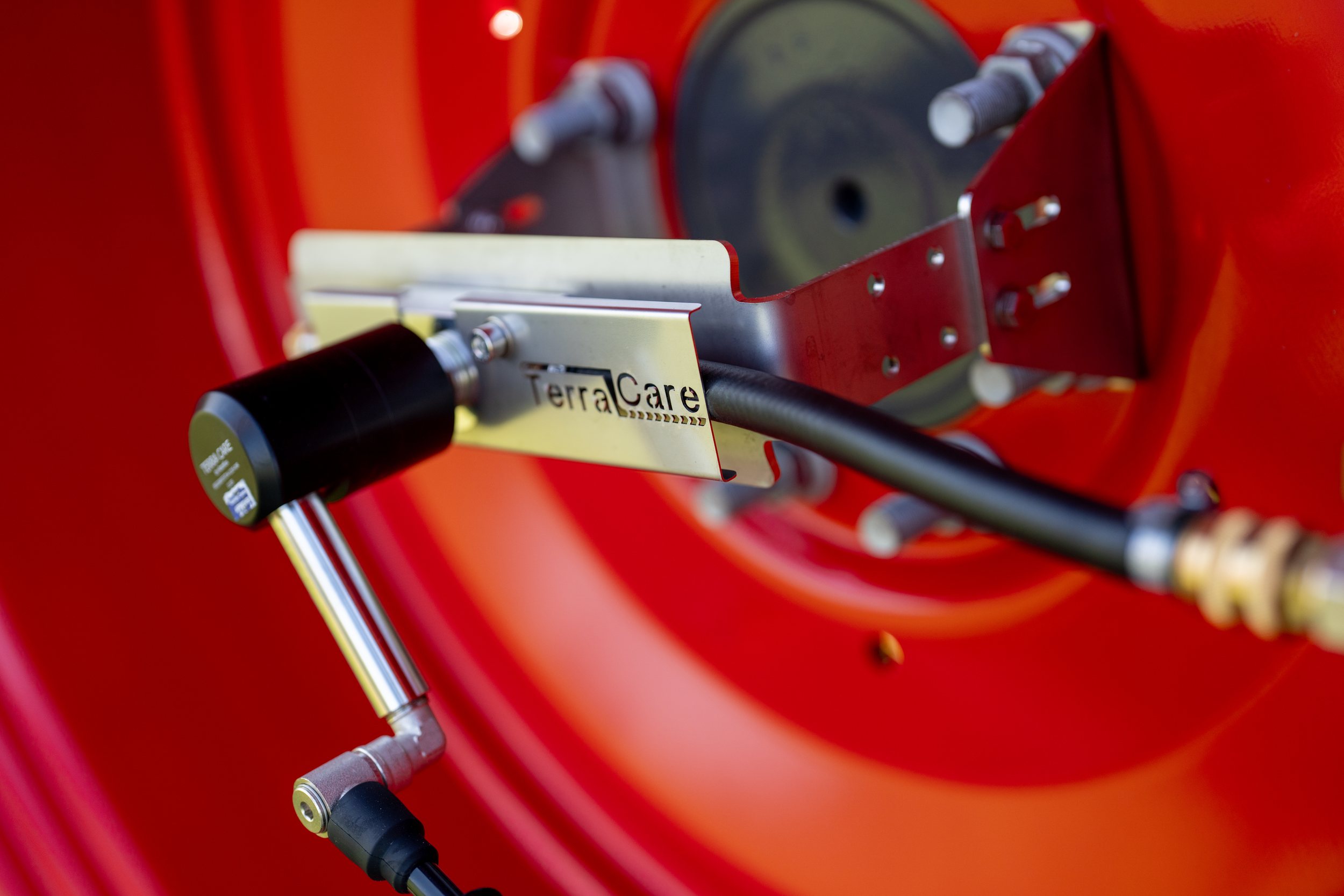
TerraCare central tire pressure inflation systems guarantee sustainable soil management. To control the tractor’s tire pressure, the TerraCare central tractor tire inflation system is connected to the tractor’s compressor.
The tire inflation speed therefore depends largely on the tractor’s compressor capacity and, above all, on the tire dimensions. For faster inflation, an auxiliary compressor can also be mounted on the tractor: either the TerraCare AirPower or the newly developed TerraCare Airbumper.
As the outer width of a tractor does not change, TerraCare have developed an extra-flat rotary joint: the TerraTurn. It is based on the same sealing technology as standard rotary joints, but is significantly flatter—making it particularly suitable for adjustable axles and high planetary gears (the outermost parts of the tractor’s front axle). If the tractor is equipped with adjustable axles or very high planetary gears, standard rotary joints would protrude beyond the rim. To avoid this, TerraCare developed this solution using extra-flat rotary joints. Use of the same sealing technology ensures an equally long service life.
Suitable for:
– Stub axles – Adjustable axles – Special axles
TerraCare also offer an internal rotary joint for stub and plug-in axles. It is mounted on the axle stub, eliminating the need for external wiring. For these rotary joints, we also rely on our proven sealing technology with silicon carbide discs.
We only offer the internal rotary joint system for our central tire pressure inflation system in combination with our radio system, TerraCare i-control, as this configuration extends the service life of the rotary joint.
Suitable for:
– Rear axles on tractors with stub axles
Connecting line between the tractor, compressor, and trailer. ¾” compressed air hose (connection to the air reservoir, if present) and connection to the brake system’s air reservoir.
The ISOBUS option is available as an alternative to controlling the central tire inflation system via the TerraCare display. This allows control of the tractor CTIS via the ISOBUS terminal pre-installed in the tractor.
– Intuitive operation – Various tractor brands available
The system can save a position via GPS; upon passing this point or these boundaries, it automatically switches to field mode and deflates the tires. GeoCare prevents users from forgetting to deflate the tires and driving into the field with excessive tire pressure.
– No GPS pre-installation required on the tractor—can be retrofitted to any TerraCare central tire inflation system for tractors – Automatic switching from road mode to field mode – Position for switching is saved with the push of a button
Additional rim connections for maintenance/dual tires: tire sizes for both sets of tires (maintenance and standard) can be stored in the control unit. This enables easy tire changes.
Upon request, the external lines can be designed to be removable. Includes a special coupling for disconnecting the stainless-steel hose.
With a central tire inflation system on a tractor, you can adjust the tire pressure to the specific application while driving. Using a control unit or terminal, the driver can select the desired pressure for road or field work. The system then automatically regulates the air pressure via valves and pressure lines.
In the field, tire pressure is reduced to increase the tire’s contact area. This improves traction, reduces slippage, and protects the soil. Before driving on the road, the system increases the tire pressure again, optimizing driving stability, tire life, and fuel efficiency. The driver no longer needs to manually check or adjust the tire pressure, saving both time and effort.
Tire pressure has a significant impact on a tractor’s performance. Optimally adjusted pressure ensures even load distribution, larger contact area, and better power transfer to the ground.
An automatic tractor tire pressure regulation system saves time and significantly increases ease of use. The driver can conveniently select the desired tire pressure at the push of a button without having to leave the tractor.
Other benefits include:
Automatic control significantly increases efficiency, especially when operating conditions change frequently.
Many farm operators switch between road and field work several times a day. Without a central tire inflation system, operators often drive with a compromise pressure that is not optimal for either application.
With a central tire inflation system, pressure adjustment takes just a few minutes. As a result, the tractor always operates at the optimal tire pressure. This improves traction in the field while increasing driving safety and fuel efficiency on the road.
A CTIS for tractors also sustainably reduces fuel consumption, tire wear, and soil compaction.
A central tire inflation system is useful wherever there are regular transitions between road and field or where high traction forces are required.
Yes, TerraCare central tire inflation systems are designed to be used with numerous tractor makes and models.
Before any retrofit, we check which components are suitable for the specific vehicle. This ensures that the system can be optimally adapted to technical specifications.
The high level of compatibility makes it possible to retrofit existing machines and equip new tractors.
First, a technical inspection of the tractor is conducted, followed by a consultation to determine the appropriate system solution. Next, the necessary components are installed, such as pressure lines, rotary unions, valves, the control unit, and, if needed, an auxiliary compressor.
After installation, the system is calibrated and adjusted to the tires in use. Finally, a functional test is performed, and the driver is instructed on how to operate the system.
When installed properly, the retrofit is completed in a short time and the tractor is immediately ready for use.
Whether you need a completely new system or want to retrofit a central tire inflation system on your tractor, TerraCare brings tomorrow’s innovation to the field today. The future runs on the right pressure—we’d be happy to advise you on the right solution.
You are currently viewing a placeholder content from Accessibility Widget. To access the actual content, click the button below. Please note that doing so will share data with third-party providers.
More InformationYou are currently viewing a placeholder content from Vimeo. To access the actual content, click the button below. Please note that doing so will share data with third-party providers.
More InformationYou are currently viewing a placeholder content from YouTube. To access the actual content, click the button below. Please note that doing so will share data with third-party providers.
More InformationYou need to load content from reCAPTCHA to submit the form. Please note that doing so will share data with third-party providers.
More InformationYou are currently viewing a placeholder content from Google Maps. To access the actual content, click the button below. Please note that doing so will share data with third-party providers.
More InformationYou are currently viewing a placeholder content from Mapbox. To access the actual content, click the button below. Please note that doing so will share data with third-party providers.
More InformationYou are currently viewing a placeholder content from OpenStreetMap. To access the actual content, click the button below. Please note that doing so will share data with third-party providers.
More Information